|
| Browse articles |
| RADIOLOGIC-PATHOLOGIC CORRELATION |
|
| J Clin Imaging Sci 2011,
1:42 |
|
Angiographic-CT-FDG-Pathologic Correlations of the Incidentally Discovered Adrenal Mass
Bi-Fang Lee1, Nan-Tsing Chiu1, Hong-Ming Tsai2, Hung-Wen Tsai3, Chung-Jye Hung4
1 Department of Nuclear Medicine, National Cheng Kung University, College of Medicine and Hospital, Tainan, Taiwan 2 Department of Radiology, National Cheng Kung University, College of Medicine and Hospital, Tainan, Taiwan 3 Department of Pathology, National Cheng Kung University, College of Medicine and Hospital, Tainan, Taiwan 4 Department of Surgery, National Cheng Kung University, College of Medicine and Hospital, Tainan, Taiwan
| Date of Submission | 20-Jun-2011 |
| Date of Acceptance | 30-Jul-2011 |
| Date of Web Publication | 17-Aug-2011 |
Correspondence Address: Chung-Jye Hung Department of Surgery, Medical College, National Cheng Kung University Hospital, 138 Sheng-Li Road, Tainan City 70428 Taiwan

© 2011 Lee et al; This is an open-access article distributed under the terms of the Creative Commons Attribution License (http://creativecommons.org/licenses/by/2.0), which permits unrestricted use, distribution, and reproduction in any medium, provided the original work is properly cited.
DOI: 10.4103/2156-7514.83928 PMID: 22315709
Abstract | | |
During abdominal ultrasonography of a 37-year-old man a 3.2 cm hypoechoic mass in the right hepatic lobe was found incidentally. This prompted an abdominal CT, an FDG PET/CT, and an angiography to evaluate the nature of the mass. Laboratory data showed positive anti-HBs/anti-HBe, and negative HCV antibody. The alfa-fetoprotein and liver function tests were within normal limits. Contrast-enhanced CT found an enhanced hepatic tumor and primary hepatocellular carcinoma was suspected. PET/CT revealed no abnormal FDG accumulation in the right hepatic mass. The digital subtraction angiographies of the right inferior phrenic artery and right renal artery revealed a hypervascular tumor in the right adrenal gland. Therefore, a diagnosis of a right adrenal tumor was made. Serum aldosterone, serum cortisol, and urine vanillylmandelic acid, and catecholamine were all within normal limits. Laparoscopic right adrenalectomy was performed and adrenal cortical adenoma was diagnosed on a histological study. Keywords: Adrenal cortical adenoma, angiography, FDG PET/CT, primary hepatocellular carcinoma
How to cite this article: Lee BF, Chiu NT, Tsai HM, Tsai HW, Hung CJ. Angiographic-CT-FDG-Pathologic Correlations of the Incidentally Discovered Adrenal Mass. J Clin Imaging Sci 2011;1:42 |
Introduction | |  |
Hepatocellular carcinoma (HCC) is a major cancer in the world. Taiwan is one of the areas where HCC is prevalent. Evaluation for HCC includes test for serum hepatitis B surface antigen (HBsAg), anti-HCV antibody, aspartate aminotransferase, alanine aminotransferase, alfa-fetoprotein, family history of HCC, and liver ultra-sonography. [1] Three-phase abdominal CT after intravenous (IV) contrast material injection includes precontrast, arterial phase, and portal venous phases. The HCC appears hypoattenuating at the precontrast phase, hyperattenuating at the arterial phase, and hypoattenuating at the portal venous phase. In addition, FDG PET/CT has a high sensitivity for the detection of extrahepatic metastases of HCC. [2]
Adrenal cortical adenoma is a benign tumor of the adrenal gland and appears as a well-defined homogeneous mass that are typically hypoattenuating relative to the liver on CT. [3] Adrenohepatic fusion, the age-related phenomenon, results in adhesion of the liver and right adrenal gland with partial absence of the fibrous capsule between the two organs. [4],[5],[6] Moreover, FDG PET/CT allows differentiation between nonfunctioning benign and malignant adrenal tumor. [7],[8],[9]
We report a case of adrenal cortical adenoma, developed from adrenohepatic fusion tissue that mimicked a malignant hepatic tumor on CT and ultrasonography initially, and was eventually diagnosed by angiography.
Liver ultrasonography showed a 3.2 cm hypoechoic mass in the segment 6 of the liver [Figure 1]. Laboratory data showed positive anti-HBs/anti-HBe, and negative HCV antibody. The alfa-fetoprotein and liver function tests were within normal limits. HCC was suspected in this patient because Taiwan is one of the areas where HCC is prevalent. [1] An abdominal contrast CT, an FDG PET/CT, and an angiography were performed to clarify the nature of the tumor. | Figure 1: Grayscale ultrasound sagittal image of liver in a 37-year-old patient demonstrates a 3.2 cm hypoechoic mass in segment 6.
Click here to view |
Radiologic features
Abdominal CT revealed a well-defined right hepatic mass in the precontrast phase [Figure 2a], enhanced in the arterial phase [Figure 2b], and faded in the portal venous phase [Figure 2c], that was characteristic of primary HCC.[2] Angiographies of right inferior phrenic artery and right renal artery unexpectedly revealed a hypervascular tumor over right adrenal gland [Figure 2d]. FDG PET/CT [Figure 2e] was performed upon receiving an intravenous injection of 370 MBq (10 mCi) of FDG after 6-hours of fasting. The patient stayed calmly in the supine position for 1 hour after injection. An integrated PET/CT scanner (Biograph, Siemens Medical Solutions) was used to acquire images from the head to upper thighs. The images were reconstructed with a standard ordered-subset expectation maximization algorithm. The axial spatial resolution was 4 mm at the center of the field of view. PET/CT showed normal FDG biodistribution over liver, brain, vocal cord, heart, gastrointestinal, and genitourinary systems. | Figure 2a: Adrenal cortical adenoma that developed in adrenohepatic fusion tissue in a 37-year-old man. Abdominal CT shows a well-defined right hepatic mass (arrow) in the precontrast phase
Click here to view |
 | Figure 2b: Adrenal cortical adenoma that developed in adrenohepatic fusion tissue in a 37-year-old man. Abdominal CT shows enhanced in the arterial phase
Click here to view |
 | Figure 2c: Adrenal cortical adenoma that developed in adrenohepatic fusion tissue in a 37-year-old man. Abdominal CT shows faded in the portal venous phase, which was a pathognomonic feature of primary hepatocellular carcinoma.
Click here to view |
 | Figure 2d: Adrenal cortical adenoma that developed in adrenohepatic fusion tissue in a 37-year-old man. Abdominal CT shows Angiographies of right inferior phrenic artery and right renal artery revealed a hypervascular tumor over right adrenal gland (arrow) unexpectedly.
Click here to view |
 | Figure 2e: Adrenal cortical adenoma that developed in adrenohepatic fusion tissue in a 37-year-old man. Abdominal CT shows FDG PET/CT showed normal FDG biodistribution over liver, brain, vocal cord, heart, gastrointestinal, and genitourinary systems.
Click here to view |
Pathologic features
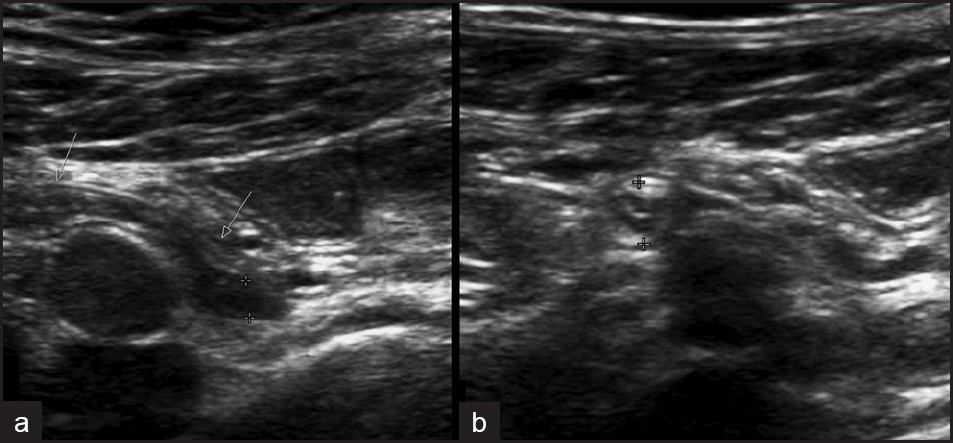
This patient decided to receive laparoscopic right adrenalectomy although the patient was asymptomatic and the tumor was nonfunctioning. Gross appearance of the specimen revealed a 3.2 cm well-circumscribed mass [Figure 3] and histology demonstrated features of an adrenal cortical adenoma [Figure 4a] and [Figure 4b].
Discussion | |  |
Our case is interesting in several aspects. First, the dynamic enhancement pattern of CT and the high prevalence of HCC in Taiwan led us to make the diagnosis of HCC in the patient. It underscores the consideration of an adrenal mass as one of the differential diagnosis of a lesion in the segment 6 of the liver. Fortunately, the accurate diagnosis of the right adrenal tumor was made from angiographic examination.
Second, the normal right adrenal gland contacts the bare area of the liver, the inferior vena cava, and the peritoneum. In our case, the intrahepatic adrenal tumor developed from adrenohepatic fusion tissue. Adrenohepatic fusion is seen in 9.9% of 636 autopsies. It is a rather common incidental finding. [4] The pathogenesis has been supposed to be a differentiation failure of the intervening fat tissue between the liver and right adrenal gland. [5] The fat plane between the liver and the right adrenal gland is not always visible on CT. [6] Angiography is helpful for the preoperative diagnosis of this rare entity.
Third, it has been well published that nonfunctional benign adrenal adenoma, being metabolically inactive, is not typically FDG avid. [7],[8],[9] On the other hand, malignant adrenal lesions display intense FDG accumulation higher than in hepatic tissue. [7],[8],[9] A normal FDG PET/CT study excludes metastasis to the adrenal gland. In our case, pathological findings demonstrated the presence of an adrenal cortical adenoma.
In conclusion, angiography is important for the preoperative diagnosis of intrahepatic adrenal tumor that develops form adrenohepatic fusion tissue. FDG PET/CT is useful in differentiation between nonfunctioning benign and malignant adrenal tumors.
References | |  |
| 1. | Lu SN, Wang JH, Chen PF, Tung HD, Tseng PL, Hung CH, et al. Community-based mass ultrasonographic screening of hepatocellular carcinoma among thrombocytopenic adults. noneCancer Epidemiol Biomarkers Prev 2008;17:1813-21.  |
| 2. | Park JW, Kim JH, Kim SK, Kang KW, Park KW, Choi JI, et al. A prospective evaluation of 18F-FDG and 11C-acetate PET/CT for detection of primary and metastatic hepatocellular carcinoma. J Nucl Med 2008;49:1912-21.  [PUBMED] [FULLTEXT] |
| 3. | Bae KT, Fuangtharnthip P, Prasad SR, Joe BN, Heiken JP. Adrenal masses: CT characterization with histogram analysis method. Radiology 2003;228:735-42.  [PUBMED] [FULLTEXT] |
| 4. | Honma K. Adreno-hepatic fusion: An autopsy study. Zentralbl Pathol 1991;137:117-22.  [PUBMED] |
| 5. | Honore LH, O'Hara KE. Combined adrenorenal fusion and adrenohepatic adhesion: A case report with review of the literature and discussion of pathogenesis. J Urol 1976;115:323-5.  |
| 6. | Woo HS, Lee KH, Park SY, Han HS, Yoon CJ, Kim YH. Adrenal cortical adenoma in adrenohepatic fusion tissue: A mimic of malignant hepatic tumor at CT. Am J Roentgenol 2007;188:W246-8.  |
| 7. | Yun M, Kim W, Alnafisi N, Lacorte L, Jang S, Alavi A. 18 F FDG PET in characterizing adrenal lesions detected on CT or MRI. J Nucl Med 2001;42:1795-9.  [PUBMED] [FULLTEXT] |

| 8. | Rao SK, Caride VJ, Ponn R, Giakovis E, Lee SH. F-18 fluorodeoxyglucose positron emission tomography-positive benign adrenal cortical adenoma: Imaging features and pathologic correlation. Clin Nucl Mednone 2004;29:300-2.  |
| 9. | Gross MD, Aram A, Fig LM, Rubello D. Contemporary adrenal Scintigraphy. Eur J Nucl Med Mol Imagingnone 2007;34:547-57.  |
Authors | |  |
Bi-Fang Lee

[Figure 1], [Figure 2a], [Figure 2b], [Figure 2c], [Figure 2d], [Figure 2e], [Figure 3], [Figure 4a], [Figure 4b]
|